


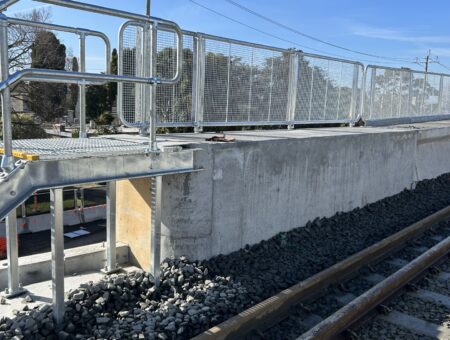
Most people never notice the fence beside a railway line. That is usually a sign it is doing its job.
A rail corridor Fencing is a live operating environment. Trains, signalling equipment and maintenance crews share the space, while homes, schools, shared paths and car parks sit only metres away. The fence between them is not just a boundary line. It is a safety system.
For project managers, engineers and procurement teams, the question is rarely whether to fence a corridor. It is which fencing to use, where, and to what level of resistance.
Why the rail boundary matters
Unauthorised access to the rail network is a measurable problem. Between 2016 and 2025, national rail regulator occurrence data compiled by the TrackSAFE Foundation recorded 71 trespasser fatalities and 112 trespasser injuries on Australia’s heavy rail network. The same data recorded 5,755 near hits with trespassers, an average of 576 a year.
Fencing does not remove that risk on its own. Signage, surveillance, education and station design all play a part. But fencing is the first physical layer of control, and its quality decides how well the other layers can work.
Separation: keeping the public and the tracks apart
Separation fencing defines where the public can go and where they cannot. On rail projects it is used along open corridors, around stations, stabling yards and substations, and at the edges of new alignments built close to existing neighbourhoods.
Level crossing removal is a clear example. On the Hurstbridge line, Lee Group was extensively involved in the removal of four level crossings and the duplication of track between Heidelberg and Rosanna. The scope included rail delineation fencing with post and mesh panels on concrete and spiked footings, alongside weldmesh fencing and gates, acoustic panels, security fencing, and chain link fencing with pedestrian and vehicle gates. The full scope is set out in the North East Program Alliance project summary.
Scale matters as well. The Mernda Rail Extension added 8km of new duplicated track and three new stations in Melbourne’s north, and it sits among the rail projects Lee Group has completed. You can see how it was delivered on the Mernda Rail Extension project page.
Anti-climb design: raising the effort needed to get in
Separation tells people where the boundary is. Anti-climb design makes crossing it difficult.
358 mesh is the most recognised example. Its tight 9mm aperture leaves almost no room for fingers or toes and resists cutting with hand tools. That is why it is specified where the consequences of a breach are high, including rail corridors, correctional facilities and defence sites. For a plain-language explanation, see what 358 mesh security fencing is and where it is used.
Anti-climb performance depends on more than the mesh. Height, top treatment, panel fixing, post spacing and the way the fence meets gates and structures all affect the result. A strong panel with a weak junction is still a weak fence.
As a general guide, the right system depends on the risk at each location:
- Weldmesh and chain link: general delineation and containment along lower-risk sections of the corridor.
- Cranked spear top tubular steel: stations and public-facing boundaries where appearance and visibility matter.
- 358 mesh: higher-risk locations where climbing and cutting resistance is the priority.
The full range sits under Defcon security fences.
Building beside live rail
A specification only works if it can be installed properly. Sloping ground, rock, drainage, cabling and operating tracks all influence where posts can go and how panels are set out. Defcon 358 fencing can be adapted to sloping terrain, rocky ground and infrastructure-heavy environments such as rail corridors.
Working next to live rail also demands strict safety standards and precise execution, which is why contractor accreditation matters. Lee Group is Level 3 Railways Accredited and designs rail fencing to meet Victorian Department of Transport requirements. Current accreditations are listed on the certifications and accreditations page.
Access points deserve the same attention. Maintenance gates are a common weak point, so they should match the fence in design and material. Lee Group’s gates and automation range covers sliding, cantilever and swinging options.
Five questions to ask before specifying rail fencing
- What is being protected, and what is the consequence of a breach?
- Who is nearby: schools, shared paths, stations or residential boundaries?
- Which authority requirements apply to this corridor?
- How will maintenance crews and vehicles get in and out?
- Does noise from the corridor also need managing along the same boundary? If so, consider noise walls and acoustic fencing in the same design.
The same principles apply beyond rail
The logic of separation and anti-climb design carries into other high-consequence sites. At Barwon Prison, 358 mesh was used for the exercise yard and cell roof panels, with anti-climb duct added above the pre-cast perimeter wall. The mesh was chosen because it is very difficult to climb or penetrate, yet remains transparent enough for clear camera surveillance. A data centre perimeter case study applies the same thinking to critical digital infrastructure.
More examples are collected under public infrastructure and in the Lee Group case studies.
Speak with a team that works in live rail environments
Lee Group supplies and installs fencing and gates for commercial and industrial projects only, including rail, public infrastructure and high-security sites. To discuss a corridor, yard or station boundary, call (03) 9484 4544 or review the rail sector page.
What does your corridor boundary need to withstand?
Frequently asked questions
What is rail corridor fencing? Rail corridor fencing is the perimeter and separation fencing that keeps the public away from operating tracks, yards, stations and associated infrastructure. It is designed to meet the requirements of the rail authority responsible for the corridor.
What is anti-climb fencing? Anti-climb fencing is designed to make climbing or cutting difficult. 358 mesh, with its 9mm aperture, is a common example. Height, top treatment and fixing details also affect performance.
Does fencing stop trespass on its own? No. Fencing is the first physical layer of control. It works best alongside signage, surveillance, education and good site design.
Does Lee Group install fencing for homes? No. Lee Group works on commercial and industrial projects only.
Sources
- TrackSAFE Foundation, Fatalities and injuries on the Australian heavy rail network, which draws on Office of the National Rail Safety Regulator occurrence data.
- Victoria’s Big Build, Works kick off for Mernda.