


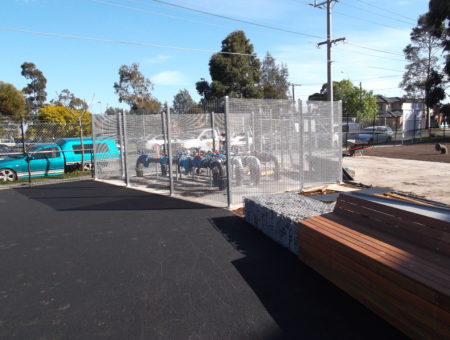
358 mesh security fencing is a welded steel mesh panel with an aperture so small that fingers cannot fit through it, and a wire so closely spaced that conventional bolt cutters struggle to gain purchase. The name “358” refers to its three defining measurements in imperial units: 3 inches by 0.5 inches by 8 gauge wire, or approximately 76.2 mm by 12.7 mm by 4 mm in metric.
It is the standard for high-security perimeter fencing in correctional, mental health, defence and critical-infrastructure environments across Australia.
Why 358 mesh is anti-climb and anti-cut
Two properties make 358 mesh distinct from standard chain link or welded mesh.
Aperture.
At 76.2 mm by 12.7 mm, the openings are too narrow for a hand or foot to enter and gain purchase. A climber cannot get a grip, and tools cannot easily be passed through the panel.
Wire gauge and weld.
The 4 mm wire is welded at every intersection rather than woven. That weld pattern resists the prising and lever attacks that defeat woven mesh, and the gauge resists most hand cutters. A determined attacker with power tools can still defeat the panel, but the time required is significantly longer, which is the point. High-security fencing is about delay, measured in the minutes added before a breach succeeds, not about being impenetrable.
Where 358 mesh is used
In Australia, 358 mesh appears wherever the security risk profile justifies its cost and where the visual transparency of mesh is preferred over solid panels. Common applications include:
- Correctional facilities and youth justice precincts
- Forensic and secure mental-health facilities
- Defence sites, both perimeter and internal compounds
- Substations, switchyards and major utilities assets
- Data centres and telecommunications exchanges
- Water treatment and storage sites
- Airport airside boundaries and freight zones
- Border control facilities
It is also increasingly specified for commercial sites that previously used palisade or standard welded mesh, where the threat profile has risen or where insurer requirements have tightened.
How it compares to chain link and standard welded mesh
A standard chain link fence is woven, has a larger aperture, and is straightforward to climb or cut. It is suitable for boundary demarcation, animal control and lower-risk commercial sites.
A standard welded mesh fence has welded intersections but a larger aperture and a lighter gauge than 358. It offers better anti-prising performance than chain link but does not meet the anti-climb and anti-cut thresholds of 358.
358 mesh sits at the top of the Defcon security fence family. It is heavier, more expensive per linear metre, and more demanding to install correctly, with closer post spacing and specific clamp details required to maintain its security performance
Specification points to confirm
When specifying 358 mesh, project managers should confirm:
- Panel height (commonly 2.4 m, 3.0 m and 3.6 m, with taller variants available)
- Whether toppings are required (razor coil, rotating spikes or extended electrified outriggers)
- Coating system (galvanised, galvanised plus powder-coat, or marine-grade specifications for coastal sites)
- Post fixing detail (in-ground concrete, base-plated, or onto an existing structure)
- Clamp and fastener system, including anti-tamper or one-way security fasteners
The clamp and fastener detail is the most commonly under-specified element, and it is the easiest point of attack on an otherwise sound panel.
How Lee Group manufactures 358 mesh
Our Preston manufacturing facility enables Lee Group to deliver fully integrated, in-house fabrication services for custom steel posts, gates, and project specific components. Supported by advanced manufacturing capabilities, experienced tradespeople, and rigorous quality control, we maintain complete oversight of every stage of production. This allows us to deliver consistent quality, greater flexibility, and reliable project outcomes for some of Victoria’s most demanding infrastructure projects.
Frequently asked questions
What does 358 mesh mean?
The name refers to the panel’s imperial dimensions: 3 inches by 0.5 inches by 8 gauge wire, or roughly 76.2 mm by 12.7 mm by 4 mm in metric.
Why is 358 mesh anti-climb?
The 76.2 mm by 12.7 mm aperture is too narrow to admit a hand or foot, so climbers cannot get purchase on the panel.
Where is 358 mesh fencing used?
Correctional, mental-health, defence, critical-infrastructure, data centres, utilities and any other high-security perimeter where anti-climb and anti-cut performance is required.
Is 358 mesh stronger than chain link?
Yes. The smaller aperture, heavier wire and welded intersections make it significantly more resistant to climbing, cutting and prising than woven chain link.