


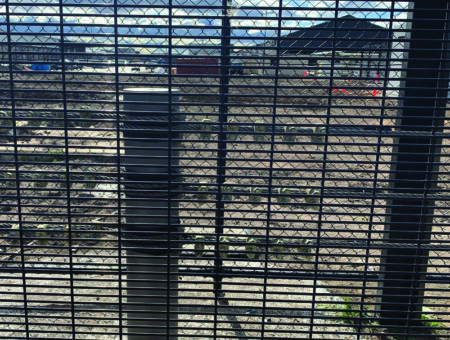
Hostile Vehicle Mitigation (HVM) fencing is a crash-rated perimeter system engineered to stop or slow a vehicle being driven at a site as a threat. Unlike standard security fencing, which is designed to deter climbing or forced entry by people, HVM fencing is tested and certified to absorb the kinetic energy of a vehicle impact at a specified weight and speed.
It is used wherever a vehicle-borne attack, accidental ramming or unauthorised vehicle incursion would create an unacceptable risk to people, assets or operations.
What does “crash-rated” actually mean?
A crash-rated fence has been physically tested under one of three internationally recognised standards. Each standard records how a real vehicle of a defined weight, travelling at a defined speed, behaved when it struck the barrier.
The standards most often called up in Australian specifications are:
- PAS 68, a British publicly available specification, now largely superseded by IWA 14-1
- IWA 14-1, the current international workshop agreement and global benchmark
- ASTM F2656, the United States standard, commonly seen on defence and embassy projects
A typical rating reads something like “IWA 14-1 V/7200[N3]/80:90”. That tells the specifier the vehicle weight (7,200 kg), the impact speed (80 km/h) and the penetration distance (under one metre). For project managers and security consultants, the rating is the only reliable way to compare products. A fence described simply as “high-security” or “anti-ram” without a tested rating offers no measurable protection.
When is HVM fencing required?
There is no single national rule that mandates HVM fencing across all sites. Instead, the requirement is driven by a site-specific threat and risk assessment, often informed by the Australian Government’s Protective Security Policy Framework (PSPF) and, for crowded places, Australia’s Strategy for Protecting Crowded Places from Terrorism.
Common Australian deployments include:
- Defence bases and Department of Defence facilities
- Diplomatic missions and consular premises
- Data centres and critical telecommunications sites
- Water, gas and electricity public infrastructure
- Ports, airports and freight terminals
- Correctional facilities with vehicle-access risks
- Stadiums, event precincts and pedestrianised public spaces
- Government buildings and judicial precincts
The trigger is rarely “the law requires it”. The trigger is usually a risk assessment that identifies a credible vehicle threat and a downstream consequence that the organisation cannot tolerate.
Bollards or anti-ram fencing: which is right?
The two solutions are often used together. Bollards work well at vehicle entry points, pedestrian thresholds and short, defined frontages. Anti-ram fencing works better across long perimeters, sloped ground, and sites where a visible deterrent is also required.
In practice, a well-designed perimeter uses fixed and operable bollards at gates and crossings, with crash-rated fencing or rated wall systems along the remainder of the boundary. The two products are specified to the same impact rating so the perimeter performs as a single system. Where vehicle access is required, automated gates are integrated to match the rated perimeter.
What should you specify?
A defensible HVM specification includes:
- The reference standard (IWA 14-1, ASTM F2656 or PAS 68)
- The required vehicle weight and impact speed
- The maximum allowable penetration
- Foundation and ground conditions, since most ratings assume a defined footing
- Integration with gates, bollards, pedestrian access and CCTV
Lee Group manufactures the Defcon Anti-Ram range in-house at our Preston facility, to Australian Standards and against the impact ratings called up by the project. Each installation is engineered to the site’s foundation conditions, not retro-fitted from a generic catalogue product. To discuss a project specification, contact our team.
Frequently asked questions
What is hostile vehicle mitigation?
A set of physical and procedural measures designed to stop a vehicle being used as a weapon or as a means of forced entry. Fences, bollards, gates and road geometry are all HVM tools.
What standards apply to anti-ram fencing in Australia?
IWA 14-1 is the current international benchmark. PAS 68 and ASTM F2656 ratings are also widely accepted on Australian projects.
Where is HVM fencing required?
At any site where a vehicle-borne threat has been identified through a security risk assessment. Defence, government, critical infrastructure, data centres and crowded public places are the most common.
What is the difference between bollards and anti-ram fencing?
Bollards protect points of access and pedestrian thresholds. Anti-ram fencing protects long perimeters. Most secure sites use both, specified to the same impact rating.