


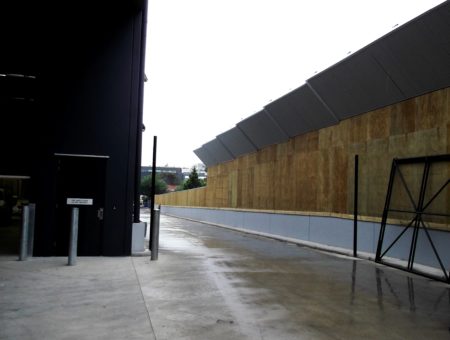
A VicRoads-engineered noise wall is a structurally certified acoustic barrier designed and approved for freeways, arterial roads and other major Victorian infrastructure projects. A standard acoustic fence is an acoustic barrier built for boundary and commercial applications where the structural and certification demands are lower.
Both reduce noise. The differences are in engineering, wind loading, approvals and the type of project each is suited to.
What makes a noise wall “VicRoads-engineered”?
VicRoads, now part of the Department of Transport and Planning, publishes structural and acoustic requirements for any noise wall built along a Victorian freeway, arterial road or declared road reserve. To be accepted on those projects, a noise wall must be:
- Designed to the specified wind loads for the corridor
- Engineered for the post embedment, panel deflection and connection details set out in the relevant standard drawings and technical notes
- Verified for acoustic performance against the project’s noise model
- Documented with engineering certification suitable for road-authority sign-off
A standard commercial acoustic fence, by contrast, is typically built to AS 1170 wind loads for a suburban or industrial setting and certified to the relevant boundary-fencing standards. It is acoustically effective for its setting, but it has not been tested or certified against freeway-corridor wind, structural and durability conditions.
How the two compare
| Feature | VicRoads-engineered noise wall | Standard acoustic fence |
|---|---|---|
| Typical setting | Freeways, arterials, rail corridors | Industrial estates, commercial boundaries, distribution centres |
| Wind load | High, corridor-specific | Standard regional wind loads |
| Height | Commonly 3 to 6 metres or more | Commonly 1.8 to 3 metres |
| Materials | Heavy-gauge steel posts, engineered panels, certified acoustic infill | Colorbond, plywood, lightweight steel |
| Certification | Project-specific engineering plus road-authority approval | Manufacturer or installer certification to relevant standards |
| Lead time | Longer, due to engineering, sign-off and manufacture | Shorter |
| Cost per linear metre | Higher | Lower |
When do you need a VicRoads-engineered solution?
You need a VicRoads-engineered noise wall when the project is on, adjoining or affecting a declared road reserve, when the wall is part of a Major Transport Infrastructure Authority project, or when the acoustic model requires a height or performance that a standard fence cannot deliver compliantly.
You can use a standard acoustic fence when the application is private boundary mitigation, a commercial or industrial site, a warehouse loading-area boundary or any other setting where the wind and structural demands of a freeway corridor do not apply.
Specification points project managers should confirm
Before going to tender, confirm:
- Whether the corridor falls under road-authority jurisdiction or council jurisdiction
- The wind region and any project-specific structural notes
- The acoustic target, often expressed as insertion loss in decibels at a defined receiver
- Foundation type and any utilities clash
- Whether the wall needs anti-graffiti coating, absorption on the traffic face, or transparent panels for sight lines
These five points determine whether the project needs a fully engineered solution or a standard acoustic product, and they prevent costly redesign once procurement is underway.
How Lee Group delivers both
Lee Group manufactures Colorbond, timber plywood, heavy-duty and VicRoads-engineered acoustic systems in-house at Preston. The same team that supplies a standard acoustic boundary fence for a distribution centre also delivers freeway and arterial noise walls engineered to road-authority requirements. That single point of accountability matters when a project crosses both worlds, for example a logistics estate fronting a freeway, where the boundary changes character along its length.
Our ISO 9001, ISO 14001 and ISO 45001 certifications, VicRoads pre-qualification for Noise Wall supply and install and our roadways and public infrastructure project history mean specifications written for road-authority sign-off can be delivered without subcontracting the engineering or the manufacture.
Frequently asked questions
What is a VicRoads-engineered noise wall?
A noise wall engineered and certified to meet the structural, wind and acoustic requirements set out by the Victorian road authority for freeways and arterial roads.
How tall can a noise wall be?
Standard acoustic fences are usually 1.8 to 3 metres. Engineered noise walls along major roads are commonly 3 to 6 metres or higher, designed to the corridor’s acoustic model.
What materials are used for freeway noise walls?
Heavy-gauge steel posts with engineered Colorbond, timber plywood or proprietary acoustic-absorptive panels, depending on the project’s acoustic and visual requirements.
Do noise walls need engineering certification in Victoria?
Yes, for any wall on or adjoining a declared road reserve. Private boundary acoustic fences must meet relevant Australian Standards but not road-authority certification.